 Train to Soul Junction
 The Wrong Speed
 Low-Fi Futures
 Only what is switchable is at all
 Girl Math and the Politics of Value
 Editor's Introduction: Issue 3 (2025)
 How to Grow A Movement
Train to Soul Junction
By Anand Subhash Borse
Note from the Director
Anand Subhash Borse
Train to Soul Junction is an invitation to slow down and ponder over things that pass by unnoticed. What are we looking for? Is there anything to look for out there in the world? Are the desires we so vehemently chase even our own desires? Or are our dreams and desires being sold to us? Who are we? Where have we come from? Where are we heading? What do we do? Life is between the moments we think we live for. The beauty of life lies in things we do not actually worry about. The beauty of life lies in things we don’t dream of. It is in the things that are around us…we just need to open our eyes and see…the answers are already around us!
Biography
Anand Subhash Borse is an independent researcher based in London. He believes that life is beautiful, and entrusts in the medium of cinema to poignantly capture such a mantra. Led by a deep spiritual curiosity, Anand views film as a window into an inner dimension. This passion drives his ongoing research, exploring cinema not just as entertainment but as a means for meaningful personal reflection and profound spiritual connection.
Note from the Producer
April Wei-West
Surrounded by the constant spell of dizzyingly absurd noise, how do we attain some spiritual reprise? We are so heavy-burdened with the deterriotorialising forces capitalist desire that any sense of peace – personally and communally – seems out of reach. It is a state of neoliberal paralysis that has fogged up that machine of very cognition, of creativity, of legitimately engaging with the world. Should we not be able to slow this rushing of the train that is pummelling towards some doomed fate, we can at least guide the train to pause at the “soul junction.”
In this film, slow cinema is employed to open up this possibility. Slowness as a solution offered to excess of speed is not an indication of regression, but rather the curation of space for meaningful contemplation found within the very rush of exacting over stimuli embedded in the post-digital everyday. Slow cinema decisively plays with attention and boredom as a means for meditation, stimulating clarity of mind–body constitution. It encourages a base level of physical wellbeing that can be a foundation for an ethics of care to be extended into critical questioning of power and desire configured in our contemporary political economies.
The Wrong Speed
Left Accelerationism and The Need for a New Left Chronopolitics
By Marcus Gilroy-Ware
That future in which we are safe from the dangers we face and our quality of life meaningfully improved has never in my own lifetime felt more distant. Prior movements for change that actually achieved something in historical terms – independence or civil rights movements – continue to haunt the political imaginary with precedents for the victories that are still to be won, tempting us with a cruel optimism about what we “should” be able to manage. Speaking to journalists or podcasters about my work, I have regularly been asked, “What are we going to do about all this?” On one occasion, I have even been required by editors to include “solutions” in my writing on these topics. Within the parameters of a certain kind of simplifying journalistic or editorial bluster, this may seem like a reasonable enough question to ask, but there are overtones to how this question is posed, as if the person asking it knows deep down that there is no convincing answer I could give, that feel specific to this conjuncture.
This conjuncture is the combination of, on the one hand, a sense that “something” needs urgently to be done, and on the other, a profound bankruptcy of imagination and aversion to disruption when it comes to what that something should be. It is not only exhausting but also characterises the bleak paralysis and profound crisis of political agency of our moment. Faced with horrific violence in Gaza, Ukraine, Sudan and many other places, widespread mental health crises and cognitive burnout, increasingly difficult economic conditions, and most of all a terrifying climate emergency, it is no wonder that the answers are elusive. The political imagination is as historically contingent and vulnerable to the conditions of its moment as any other part of the conjuncture, and it is the theories and “paths of escape” imagined under these conditions of fatigue and collective impotence that I wish to explore here. The “disappearance of the future” has been remarked upon for decades, but seldom in these analyses has that disappearance been total and permanent. In the Jameson-Zizek-Fisher analysis of this cultural dynamic, any totality has been cast as an ideological illusion in itself, if an overwhelming one – an artificial appearance of the foreclosure of alternatives or escape as part of how the very system works. But the analysis generally implies a small ray of light, however remote or unlikely, that implies a possible way out of the mire of post-postmodern, “capitalist realism”. In addition to its accessibility and cultural literacy, what made the book by that name a classic of its time was surely that, however gloomy its view of the cultural landscape at the moment when it was written, it still encouraged a belief in the possibility of an “emancipatory politics”. When Fisher died in 2017, it was a much-quoted passage describing the strategic imperatives to which that emancipatory shift must be subject that his students spontaneously wrote on an outside wall at Goldsmiths in his memory:
“emancipatory politics must always destroy the appearance of a ‘natural order’, must reveal what is presented as necessary and inevitable to be a mere contingency, just as it must make what was previously deemed to be impossible seem attainable.” (2009)
At the moment at which Fisher wrote these words, the difficulties were already apparent. In the years following the 2008 financial crisis, a range of movements and discourses had emerged that in seeking to challenge the prevailing order, had quickly stalled, become exhausted, or been ruthlessly crushed. In the UK, the student protests of 2010 were met with the introduction of “kettling,” which signalled the limits of dissent within the existing order. In the United States, the 2011 Occupy movement, despite its global visibility, struggled to translate its procedural commitment to horizontality and inclusion into a sustained political vision.
Almost a decade since Fisher passed away, however, the vision of that emancipatory future remains elusive. The work of defending the incomplete emancipatory battles of the past is already so exhausting that engagement with the battles of the future is frequently overlooked or underestimated. The consequence has sometimes verged towards a disproportionate focus on strict categories of personal identity and self-definition, sometimes more detached from broader structural critique, or applying it in an undialectical and simplistic fashion. Upon Fisher’s death, some of those people most invested in this type of politics who he had categorised as “sour-faced identitarians” gloated over his death (Nagle, 2017). While we must continue to express our rage about what is happening, and our petitions, leaflets, demonstrations and sit-ins must not cease, the ways we imagine and communicate and build the future are important alongside our cultural and political memory if we are to survive at all.
There is a lot to be said about the “chronopolitics” of the reactionary right in the current conjuncture: the strange mix of optimism (e.g. Trump’s reappropriation of “Make America Great Again” in 2016 and 2024; Turkey’s AKP, whose 2023 slogans included “We will walk into the future together;” and Argentina’s Milei, whose 2023 presidential slogan was “The only solution”) with regression and reterritorialisation of a lost, bygone era. Key to the conjuncturally specific relationship between emancipatory politics and the reactionary right in our current moment, however, is the “hegemonising” of emancipatory discourses as a kind of political fuel for these movements has become clearer. It is of course an essential premise of the historical materialist worldview that all culture exists only in a specific historical context. Emancipatory politics is no exception, and it is precisely this fact for which many contemporary progressive causes have failed to account. Today, ideas that were once revolutionary or the subject of sustained emancipatory movements, such as universal suffrage, remain in a bizarre, contradictory, hollowed-out zombie state of non-existent existence. It is not just that because, as Fisher observed, paraphrasing Zizek, “anti-capitalism is widely disseminated in capitalism” in the sense of arguments specifically about “capitalism” as a system.
Rather, so hegemonic has this discourse become that in a much broader sense, the racism of anti-immigration protests must be denied for mainstream acceptance (e.g. Pearson, 2025), green-sounding discourses are a common, if not essential part of contemporary climate destruction (de Freitas Netto et al. 2020), feminist-sounding discourses feature regularly in some of the newer misogynies (Banet-Wiser 2018), and so on. Whether it is Pride marches, Black History Month, or International Women’s Day, it is organised in ultimate collaboration with the same oppressive structures of capital that have long oppressed minorities. Exemplifying what Olúfémi Táíwò has termed “elite capture” (2022), elements of what was once genuinely emancipatory thought—environmentalism, feminism, anti-racism—have increasingly assimilated into the language of corporate and institutional power, in ways that further neutralised their already-waning political edge. In other words, what Wendy Brown has called the “historically outmoded character of liberal democracy” (2025) has, through its development of a kind of rainbow-green-feminist branded corporate camouflage of progress, both neutralised the politics of emancipation and emboldened its enemies by assuming its messages and promises in increasingly complex guises since the 1990s, all while violating them mercilessly at the structural level.
Discursively prominent and widely accepted by a large section of most populations those promises may be, they are also hollowed by decades of neoliberal governance, and too materially incongruent with most people’s lived realities to have much of an emancipatory impact. Meanwhile, they are under renewed attack by a loud minority of the reactionary population, who have already turned explicitly against the same values, mistaking the inner corruption and injustice of capital that dominates their material conditions for the gleaming egalitarian, eco-friendly costume it wears, conflated in the now-pejorative label “woke”. In other words, continued, straightforward advocacy for these once-revolutionary emancipatory causes, however important, is essentially a trap. Double down, and you are ensnared into rehearsing an out-of-date argument to which most are already thoroughly, if sub-consciously, desensitised, becoming complicit in the co-optation and anachronistic progressive self-parody so derided by the angry ones and the apathetic ones alike. Say nothing, and your silence is taken as consent by all parties. It is in precisely this type of predicament – zero political power, the victories of the past exhausted yet under renewed threat, and the future somehow undiscernible – that impotence starts to turn to desperation, and humiliation into rage.
Paralysis, acceleration and rupture
In the shadowy background of Western neoliberalism, particularly since its “end of history” moment, the emergence of strange ideas and political impulses anticipating rupture, sabotage, or ‘switching sides’, has accumulated a parallel history, with their own contributions to the true meaning of “reactionary.” Amongst this detritus, people started to turn for answers toward a series of related but distinctive theories known as “accelerationism.” The relationship between acceleration itself and modernity has been the subject of valuable critical social theories in itself (Rosa 2013; Wajcman, 2015). However, with (or without) a variety of guiding principles, “accelerationism” is essentially the political name for the deliberate intensification of deterritorialisating forces of capital when forms of resistance do not appear to work.
There is a standard genealogy of accelerationism that usually starts with Nietzsche’s call to “accelerate the process”, and develops via Deleuze and Guattari (1972) and Lyotard (1974) a full account of which is beyond the scope of this article and has been helpfully summarised elsewhere from a variety of perspectives (Noys, 2014; MacKay and Avenassian, 2014). Increasingly, “accelerationism” came to be associated with the prolific reactionary thinker Nick Land, whose own version of accelerationism drifted toward a technologised anti-humanism, in which humans (or “meat puppets”) should essentially die out and be replaced, through intensified market logics that Land saw as an artificial intelligence. In the 1990s, Land had formed the “Cybernetic Cultures Research Unit” (CCRU), which can be summarised as a cult-like “real-life 4chan meets cultural analysis” group of philosophy staff and students collectively exploring this same impulse at the University of Warwick, where he worked before resigning his post and eventually moving to China. While many of these individuals, of whom Mark Fisher was one, did not necessarily share Land’s increasingly reactionary views, the CCRU were tightly bonded as a group and enjoyed the militaristic overtones of ‘unit’ (Beckett, 2017). Sadly, very few to this day, even those still nominally on the left, have condemned outright the darkly anti-humanist impacts of Land’s work, except perhaps in narrow, scholarly quibbles–even after he came to be the alt-right’s favourite philosopher, years later (Blincoe, 2017).
One proposal in response to the strangle-hold that neoliberalism appeared to have on the world, and the perceived inefficacy of the political movements fighting it, has been that of “Left Accelerationism.” Inspired in part by dialogue between Mark Fisher and its authors Nick Srnicek and Alex Williams (Beckett, 2017), the idea first arose in a document titled “#Accelerate: Manifesto for an Accelerationist Politics” (MAP), which claimed to revive and apply the broader project of accelerationism to this stagnation, for and from within the left (Srnicek and Williams, 2013). After much critique, enthusiasm and discussion, its authors followed up two years later with a book – Inventing the Future (2015) – that elaborated on its ideas but quietly ditched the explicit embrace of accelerationism as a philosophy, while elaborating many of the suggestions and critiques of MAP.
In this issue, we collectively appraise the applicability of the project of “left accelerationism” for the seeming slow-motion apocalypse of our current conjuncture. However, I want to emphasise that both publications were authored more than a decade ago, prior to the emboldening of far-right reactionary politics to which I have referred, at a time when a blander liberal democracy still held a tight grip and a vestigial sense of legitimacy for many. Without this concerning wave of mainstream regressive politics, in parts of which Nick Land would come to be such an important figure (Burrows, 2019), it is understandable why elements of the left thought it was worth experimenting: if the stagnant present appears to live in the past, and that past has been ruthlessly co-opted by your political enemies in the present, then let’s bring about the future by any means necessary. In hindsight, this impulse in itself has a petulance that feels somewhat reckless, if not reactionary in its own small way. It would be profoundly unfair to engage both critically and retrospectively at this conjuncture, as I have been asked to do, with the project of “left accelerationism” as though it were proposed more recently. However, without the option of stepping back to 2013 for a chat (and left-accelerationists have not yet been able to invent time travel), it is impossible to redeem what might have been right about this contribution unless we also critique in some measure the aspects of this train of thought that were profoundly misguided. Before either of these analyses however, I want first to illustrate the starting objections of MAP to its own conjuncture, in its own words:
“The most important division in today's Left is between those that hold to a folk politics of localism, direct action, and relentless horizontalism, and those that outline what must become called an accelerationist politics at ease with a modernity of abstraction, complexity; globality; and technology. The former remains content with establishing small and temporary spaces of non-capitalist social relations, eschewing the real problems entailed in facing foes which are intrinsically non-local, abstract, and rooted deep in our everyday infrastructure. The failure of such politics has been built-in from the very beginning.” (Srnicek and Williams, 2013)
What did the left accelerationists get right?
There were certain ingredients that gave the Left-Accelerationist project significant merit. Even if some might contest the wording above, one area where at least the kernel of the project was valid was in highlighting the over-engagement in emancipatory movements with strategies drawn from the victories and traumas of the past. For all the inspiration historic instances of overcoming oppression might provide, pastiching the strategies and epistemologies of past conflicts and victories, especially when neoliberalism has already appropriated them, is not always the correct approach. The call was not one for amnesia, but for a recognition of the contingency of specific forms of action: “No given mode of political action is historically inviolable,” they wrote. Just because something has worked before, there is no reason that it should be considered an easy means of success in future. “Indeed, over time, there is an increasing need to discard familiar tactics as the forces and entities they are marshalled against learn to defend and counter-attack them effectively. It is in part the contemporary Left's inability to do so which lies close to the heart of the contemporary malaise.” (Srnicek and Williams, 2013)
Over-engagement with past simulacra is strewn across the political landscape. As I have discussed above, many of the very areas of politics that we now find ourselves fighting anew – nationalism, misogyny and xenophobia – also entail a mythologisation of simpler, earlier modernities. For emancipatory movements, the effect of looking back at the past for inspiration, or indeed for political issues themselves, does seem to create a kind of exaggerated ethical self-critique that results in paralysis. Aspects of collective strategy such as a commitment to secrecy, or a consideration of entrepreneurship as a means of resolving the harsh irony that you sometimes need capital to fight capital, are in my experience quickly shut down as wholly unethical, simply because our political adversaries also use them.
Finally, perhaps one of the most valuable insights in Srnicek and Williams’s project was that the left could not afford to be outright technophobic or anti-science, just because technological projects are produced from capitalist markets. Indeed, an undeniable alienation of emancipatory politics from digital skills and scientific literature has arisen. While our electricity still runs and our phones still connect and charge, the fact that so few within left circles seem literate in technological foundations such as software engineering of microprocessor design has always concerned me for the forms of dependency it creates, if for no other reason. Likewise with science, despite the corrupt, apolitical histories of scientific research or even its enduring entanglements with stock markets and hedge fund portfolios of our moment, and the need for healthy caution, we cannot afford the out-of-date heuristic of suspicion, now very common on digital media platforms like Instagram, that conflates neuroscience, biochemistry, epidemiology or any other areas of scientific enquiry with these historical and discursive misuses and thus verges away from historical materialism into illiteracy, danger and disease, as the pandemic has since shown. Not only could these areas of knowledge be invaluable in guiding some of the pragmatics of emancipatory politics, like technological literacy, but they can also provide invaluable should the material conditions of existence that support digital technology rapidly degrade in some kind of crisis.
The recognition that alienation from technology is unhelpful to would be reparative or anti-capitalist movements is by no means unique to the “Left-Accelerationist” project I address here, nor does such a view constitute any type of accelerationism at all. On the contrary, as Wajcman has observed, “An implicit antipathy to science and technology forecloses appreciation of the scope that digital technologies might afford for control over time, enabling people to have not only more time but time of their choice.” The (unevenly and variously kept) promise of all technology at the individual level is invariably that it extends its user’s agency. While this narrative has long been regarded as misleading (van Dijck, 2009), it is still understandable why a general crisis of agency should point to exploration of available technologies as one starting point. The “Xenofeminist manifesto” is another, simple example of political thinking that has called for a re-approximation technology:
“the situation requires a feminism at ease with computation. Today, it is imperative that we develop an ideological infrastructure that both supports and facilitates feminist interventions within connective, networked elements of the contemporary world”. (Cubonicks, 2018)
It further “[urges] feminists to equip themselves with the skills to redeploy existing technologies and invent novel cognitive and material tools in the service of common ends.” Of course, in a feminist context, these words have a somewhat different resonance given the early alienation of disproportionate numbers of women and girls from technology, and STEM subjects generally (Hardey, 2019).
What did they get wrong?
So far, I have explored some of what “Left Accelerationism” got right. However, the project also entailed grave shortcomings that not only made it flawed then, but which make it profoundly unhelpful to our present circumstances too. The first very serious issue is that the scale of the task, and the nature of the enemy, has been drastically underestimated. The stated goal in MAP is to “unleash latent productive forces”, and neoliberalism, they wrote “does not need to be destroyed. It needs to be repurposed towards common ends.” There is of course no strict agreement about how exactly “neoliberalism” should be defined (Brown, 2015), but many reading these words will be briefly permeated by a shudder. It sounds like the deranged reasoning of the once-left-wing academic or public official, perhaps even a sometime firebrand of the picket line, who has become ensnared in the delusional conceptual gymnastics of senior management.
Perhaps a victim of its own historical vantage, left-accelerationism seems to have mistaken a momentary lull of “boring dystopia” where (neo)liberal capitalism came to rest after the 2008 financial crash, for a permanent stagnation. For all the “boring dystopia” of the 2010-2015 conjuncture however, both globally and in the UK, the idea that neoliberal capital, with its healthcare privatisation, relentless arms-trading, publicly-listed social media corporations, and militarised police protection had not retained its menacing character of surveillance, repression, displacement and deterritorialisation seems hard to fathom. In the follow-up book to MAP, Srnicek and Williams wrote that “the dominant tactics – protesting, marching, occupying, and various other forms of direct action – have become part of a well-established narrative, with the people and the police each playing their assigned roles” (2015). In other words, they look at the standoff between the technologically advanced, violent, and unaccountable regimes of late-neoliberal governance and “the people,” and imply that the latter are at least partially at fault for their collective inability to fight back, because their “folk politics” are, in the language of the later book, permeated with failure (2015). Even if the tactical frustrations that they hold regarding the myopia, confusion and sentimentality of emancipatory politics are not without some justification, as I have accepted, it does not follow that the conditions of disempowerment and alienation are a matter of mere strategic or technological ineptitude, nor that the foe is weak and inclined towards failure. In the student protests of 2010, there were admittedly strategic shortcomings, but the experiences of the police “kettle” were a sobering indication at that time of how quickly that neoliberal order was able to escalate when challenged. We can never afford to underestimate our opponents.
Technology
Drawing on Marx’s acceptance of technology, Srnicek and Williams also proposed that the technologies and other affordances furnished by capitalism could be the fastest path to post-capitalism if used correctly. They wrote of the need to “accelerate the process of technological evolution,” suggesting that “the true transformative potentials of much of our technological and scientific research remain unexploited, filled with presently redundant features (or preadaptations) that, following a shift beyond the short-sighted capitalist socius, can become decisive.” Srnicek later said in an interview that accelerationism, in MAP:
“meant taking an interest in the latest technology, thinking about how exactly they can be used as technologies for liberation rather than tools of control, and thinking about the ways in which we can build a world of abundance and experimentation beyond the strictures of capitalist society.” (2017)
From the underestimation of neoliberal capitalism which I have outlined above, it should already be clear that some of the project’s big technological claims, like the insistence on an emancipatory labour automation, are rendered fantastical enough that they require no real reply. Even a cursory glance at the history of labour and automation begs the question “whose automation?”. However, the relation between these ideas and the digital platforms that permeate our world even more comprehensively than they did then remains a more relevant and useful area for engagement with this theory. The first problem here is that they were already ten years too late even, when these arguments were made. In the early 2000s, as “open source” became broadly acceptable through projects such as Firefox, Wikipedia, WordPress, PHP/MySQL and GNU/Linux, an opportunity for the adoption and development of alternative sociotechnical forms arguably presented itself. The failure of left-wing political groups to explore the possibilities that may have existed then meant that the chance to build infrastructures that might have shaped our present moment was, to a substantial degree, squandered - quite possibly because of exactly the technoskepticism that MAP subsequently identified. In any event, the door was already shut by the time of MAP’s intervention, and the consumer internet, already privatised, has since been further enclosed, commodified, and technologically mystified by digital platforms and “App Stores”. The Free and Open source software movement essentially split between libertarians aligned with the Free Software Foundation and capitalist speculators fleetingly intrigued by “open source”, before pivoting to attention economics and platform capitalism once they realised there were no other ways to make money from freely distributed code.
We are therefore in a defensive position with regard to technology, in which a cautious critique of technology must play a key advisory role. Techno-utopianism will mislead everyone (as it has done recently with the quest for “Artificial General Intelligence” via large language models), which leads to a second issue with left accelerationism’s technological thesis: the relative lack of criticism in some of the more prominent calls to technologise. As Haraway (quoted in Wajcman 2015) puts it, “The issue is no longer whether to accept or oppose technoscience, but rather how to engage strategically with technoscience while, at the same time, being its chief critic.” To its credit, MAP did try to caveat technological utopianism:
“Whereas the techno-utopians argue for acceleration on the basis that it will automatically overcome social conflict, our position is that technology should be accelerated precisely because it is needed in order to win social conflicts.” (2013)
In other words, technology is not the solution by itself, but without it, many more solutions are out of reach. This is only a valid distinction when one is specific about which technologies and under what conditions. The caveat also seems to be contradicted later the words, “The utopian potentials inherent in twenty-first-century technology cannot remain bound to a parochial capitalist imagination” (emphasis added). As with their contention that technologies can be “repurposed towards common ends,” this claim thoroughly understates how deeply and indelibly capitalist priorities of extraction and repressive desublimation are sedimented, not only in technological forms, but in the reality that, ideologically speaking, form is also content–as we have known for some time (McLuhan, 1964).
A prime example of this underestimation of the challenge, and neat cauterisation of technology from the market forces that created it, is in the suggestion that digital platforms specifically might be made useful to anti-capitalist or post-capitalist projects. Platforms are still often seen in a post-Habermasian light, as fractured, uneven public spheres or counterpublics, and anxiety about “echo chambers” and “filter bubbles”, though oversimplified, continues to rehearse the view that platforms function reliably and primarily as tools of ideological amplification, even if this has never been well-supported (Zuiderveen Borgesius et al., 2016; Bruns, 2019). Occasionally, conspicuous cases seem to confirm this “loudspeaker in the public sphere” role, such as the footballer Marcus Rashford’s 2020 use of social media around free school meals in the UK, which prompted a government U-turn (Siddique, 2020). Episodes like this just are frequent enough to sustain the illusions that widespread discursive manipulation is a viable option for counter-hegemonic movements, or even that ideological disagreement and negotiation are the primary usage and social impact of digital media platforms.
Working on precisely these assumptions, MAP urged that “the Left must develop sociotechnical hegemony: both in the sphere of ideas, and in the sphere of material platforms. Platforms are the infrastructure of global society. They establish the basic parameters of what is possible, both behaviourally and ideologically” (2013). In their follow-up book, the claim verged further in this direction, asserting in the opening pages that “the internet and social media are giving a voice to billions who previously went unheard,” (2015). Years earlier however, it was already well known that, for example, “Usage of social media is highly uneven amongst participants and much content is dominated by a small percentage of people” (Fenton, 2012). Similarly, Tiziana Terranova has written that “these new technologies of the social […] open the possibility of experimenting with many-to-many interaction and thus with the very processes of individuation,” and that they draw on widely socialised knowledges and soft skills, offering “affordances […] for political action that cannot be left to capitalist monopolies” (2014). Platforms are not neutral ground and MAP does not state that it is. However, their design for attention, reaction, and distraction makes them more like booby-trapped enemy terrain than open infrastructure with which to build revolution. While they can build awareness of aspects of the crises we face, attention economies repeatedly remind us that consciousness-raising does not in itself lead to action or structural change. As I have written elsewhere, “social media are often a far more important source of non-information and even disinformation than they are a bona-fide source of trusted information” (Gilroy-Ware 2017). The dominance of recommender systems, surveillance metrics, and ad-tech has only increased in intensity and breadth, permeating social media more thoroughly and intertwining with newer affordances such as generative AI. Meanwhile, the explicitly anti-democratic, pro-technology ideas of right-wing accelerationism that became known as the “dark enlightenment” were already published when MAP was written and have since found favour at the very hearth of digital platforms and Silicon Valley (Smith and Burrows, 2021), via the work of fascist keyboard-warrior and Peter Thiel investee Curtis Yarvin. Most recently, they became the inspiration for Elon Musk and Donald Trump’s “DOGE” endeavour after the 2024 Presidental election (Foroohar, 2025).
While we must be competent and fluent in these technologies as with others—including the now-familiar technologies of conflict and attention, the option of doing so primarily on our own terms is, for the time being, foreclosed. Instead, for emancipatory political projects on digital platforms, it is “Moscow Rules” – assume nothing, trust no-one, blend in and leave no traces behind. Any role for increased technological adoption and literacy in emancipatory politics will be defensive, asymmetrical, and tactically constrained: modest productivity gains from prudent, restrained use of AI, strong encryption and other counter-surveillance, scraping, automation, disruption and sabotage against the prevailing “psychopolitical” forms. It is perfectly fair that these thinkers, in their desire to build and to hope, might not have been able to foresee the flood of apolitical or information-avoidant Tiktok and Instagram micro-entertainment that would come later, or the growth these were intended to generate through the capture of human cognition and affects. But form was content then and the same is true now. Meanwhile, Srnicek, has since proven one of the most astute and reliable commentators on the political economy of digital platforms.
Why make it “accelerationist” at all?
Having dealt with the practicalities and capitalist entanglements of technology, I come finally to the symbolic role this technology plays, and in particular the future (re)orientation that it is meant to signify, at the heart of “left accelerationism”. The question of whether, as Audre Lord phrased it, the “master’s tools” will ever dismantle the “master’s house” is as lively as it is protracted, and it is by no means an accelerationist question in itself. As its name inevitably and very deliberately conveys however, the authors of “left accelerationism,” in initially choosing the accelerationist lens, surely implied that the “master’s tools,” rather than mere practicality or strategic advantage, could have a role in intensifying the immanent contradictions and instabilities of their status quo bringing about its eventual rupture. However, subsequent to the LA project, Srnicek said in an interview with Verso that what accelerationism meant to him and Williams was the “simple idea” that “capitalism was building the basis for post-capitalism, for the movement beyond itself,” (2017) which is a very different view. It remains unclear why, other than perhaps the influence of Mark Fisher and his links to Land’s CCRU (Beckett, 2017), the project had to be forced to wear the jacket of “accelerationism” at all. Rather than being merely nominal, this objection traverses two very serious issues.
Alignment with Nick Land
The first huge issue of “Left-Accelerationism” is, ultimately, the way it initially strained to align itself with the broader epistemological traditions of accelerationism at all. In 2025, I know very few politically active people on the “left” who would not concede the practical and strategic arguments ventured in various parts of the project to some degree, especially that a greater openness to and exploration of new techniques and forms of impact is not only justified but sorely needed. From board games to cryptocurrencies to painstaking legal work to a sea of podcasts, I have the unsystematic impression at least that people are trying to do things differently. In my admittedly limited sample size however, what does make many of these same co-conspirators immediately frown or shudder, however, is the idea of being associated with “accelerationism.” Srnicek and Williams wrote that: “It is Marx, along with Land, who remains the paradigmatic accelerationist thinker. [...] Marx himself used the most advanced theoretical tools and empirical data available in an attempt to fully understand and transform his world. He was not a thinker who resisted modernity, but rather one who sought to analyse and intervene within it, [...] Its gains were not to be reversed, but accelerated beyond the constraints [of] the capitalist value form.” (2013)
Rooting so-called left-accelerationism in Marx’s grudging respect for capitalism, Mark Fisher, in response to MAP, asserted that “Everyone is an accelerationist," watering down the concept beyond any meaning, and further that “Marxism is nothing if it is not accelerationist”. I like to think that Marx himself might have been one of the first to resist such an oversimplified and all-encompassing statement. Even if not however, honestly so what if Marx was not hostile to new tools of analysis? We know he wasn’t stupid. It is a pretty big jump from acknowledging this important aspect of Marx’s work to placing his cherry-picked ideas within the framework of a writer who was already a published advocate for a “Dark Enlightenment” and believed that the dynamic forces of the market would ultimately cause humans to be replaced by AI. We could also infer from the way Marx wrote about commodity fetishism that he wasn’t exactly enthusiastic about what would later be called deterritorialisation. Rather than do all this work to make these thinkers go together, possibly because of something Deleuze and Guattari wrote or because Mark Fisher suggested it might be cool, maybe this contortion should have been a sign that accelerationism was utterly the wrong framing. If they were trying to build an effective, inclusive movement unburdened by the past, then actively seeking at least tangential commonality with the broader trend of accelerationism associated with Nick Land and the CCRU was a huge strategic miss-step.
Most accelerationisms entail a degree of iconoclastic transgressiveness in respect of established, accepted philosophical premises, although this is not constitutive of accelerationism by itself. The guiding logos I have referred to is key, here: why are we intensifying again? As Srnicek observed in an interview with Verso, he was “yet to see any interesting questions, provocations, or insights emerge from the idea that there’s a common accelerationist project that subdivides into a right and left genre” (2018). However, Left-accelerationism’s common ground with Land was at the very least that it saw the status quo of neoliberal capitalism’s camouflage within progressive-sounding values of human rights and equality as hypocritical, stagnant, and moribund, and realised something had to give way. The authors of MAP acknowledged that accelerationism was regarded as “political heresy”, but as their words above about Marx may suggest, they appeared to feel secure that accelerationism always has an oppositional relationship to capitalism: “at the basis of all accelerationist thought lies the assertion that the crimes, contradictions and absurdities of capitalism have to be countered with a politically and theoretically progressive attitude towards its constituent elements” (emphasis added). However, by the time MAP was written, this intrinsic opposition to capitalism was already well repudiated in Land’s right-wing accelerationism (e.g. 2012), which might reasonably have been regarded as “heresy” precisely because it had abandoned any meaningful aspiration to counter capitalism at all (MacKay and Brassier, 2012). Rather, its guiding logos was a nihilistic one that appeared to embrace destruction (e.g. Land, 1992). Left-accelerationism obviously diverged sharply from Land, implying that it has retained its commitments to human wellbeing and its desire for a world after and thus without capitalism. However its general alignment and proximity with accelerationism at that historical moment meant its critique of “relentlessly horizontal” “folk politics”, like Mark Fisher’s jibes at “sour-faced identitarians”, inevitably appeared to echo Land’s own, far less sympathetic sentiments about the left, articulated for example in “Critique of Transcendental Miserablism” (2007).
If, as Robin (2018) argues, “reactionary” is usually characterised by the “demarche” against historical struggles for equality, then any politics that objects to the current forms that “democracy” has assumed, however flawed, must be examined closely in how it deals with the difficult question of democratic self-determination, not only in the state but in counter-hegemonic movements. Thinking the difficulties, or even impossibilities, of ideal democratic process does not preclude an honesty about, and frustration with its practical shortcomings – particularly with the outmoded liberal forms described by Brown (2025). As Astra Taylor has noted, “Democracy is [...] a promise that can never be wholly fulfilled because its implications and scope keep changing. [...] Democracy destabilizes its own legitimacy and purpose by design, subjecting its core components to continual examination and scrutiny. [...] Democracy may not [even] exist, yet it still manages to disappoint. Political gridlock, corruption, unaccountable representatives, and the lack of meaningful alternatives incense people across the ideological spectrum” (2019). Indeed, self-critical acknowledgements of the paralysis, myopia and hypocrisy of movements at least nominally associated with progressive politics are necessary, if framed and directed respectfully. However, as soon as the call is for the difficult work of integrating, resolving and negotiating the agency and interests of diverse groups of people to be disrespected, curtailed or abandoned altogether, reactionary territory is very close at hand. The frustrations of “left accelerationism,” while they do not quite follow the general legacy of accelerationism into this territory, certainly leave an irresponsibly loud silence in how they deal with the difficult question of collective agency. Without a lot more work to acknowledge that past trauma and pain, the alternative rationalities and spiritual entanglements, and all the other “folk” traditions evoked in their nomenclature, all of which was feasible, their Euro-Atlantic rationalism never really felt like a plan for the rest of us, with or without its overt contortions into “accelerationism”.
Unless we do acknowledge that there is some kind of guiding collectivist emancipatory ethic that our movements do have in common with our antecedents, and which sever any chance of collaboration with reactionary, anti-democratic movements, and make proper space for these conversations, the argument that we should be less horizontal and “take advantage of every technological and scientific advance made possible by capitalist society” (Srnicek and Williams 2013) sounds like an argument that the left should be developing its own laser-guided bombs and funding the revolution through commercially mass-produced ultra-processed food products.
Does it actually involve any real “acceleration” at all?
The second issue with having framed this project as it was, is that even if it seeks to rebuke or distinguish itself from the worst aspects of accelerationism, the choice of this name inevitably also communicates a very clearly under-theorised relationship to temporality itself and to its relationship to modernity. I am not the only author to find this naming unhelpful: Negri wrote, in his response to MAP, “The name 'accelerationism' is certainly unfortunate, as it ascribes a sense of 'futurism' to something that is not at all futuristic” (2014). Likewise, Patricia Reed noted in her own response to MAP that its name “unfortunately, obfuscates its content” (2015). To these authors’ credit, they did stop using the term “accelerationism” and acknowledge that it wasn’t right: “We’ve given up on the term now,” Srnicek told the Guardian in 2017. “It’s been too popularised. And we don’t just want everything to go faster, anyway. Arguing for a shorter working week is arguing for people’s lives to slow down.”
According to the sociologist Harmut Rosa, “social acceleration represents one, if not the, fundamental tendency of modernity” (2013). However, in Rosa’s compelling view, the foundational acceleration “has turned against the very project of modernity that originally motivated, grounded, and helped set it in motion.” Even the climate crisis, he has said elsewhere, can be read as a pathology of acceleration: we have accelerated to a speed that outpaces nature’s ability to regenerate and adapt.
The dialectics of culture under these conditions were always guaranteed to produce calls for, and some politics of, slowness. Indeed, as Wajcman has noted, “the resignification of slowness as a life-enhancing quality has to be understood as a response to the acceleration society.” However, she argues, “there is a tension between slowness as a realm of the elite (mostly Western) individual and the need to share the pleasures of slowness equitably” (2015). Further, a fast/slow distinction is flawed because “a social movement rooted in a politics of consumption cannot fully engage with the inequalities in time sovereignty that result from money, status, and power.” (Wajcman 2015). Since these words were written, the forces of the anti-modern have become more insistent and reactionary in their own way, being not only anti-speed but anti-science, anti-tech, anti-screen, or even anti-vax. During the COVID-19 pandemic, one of the most frequent anti-vaccination arguments was that the mRNA vaccines had been “rushed” and, essentially, had not taken long enough.
What these issues suggest is that for emancipatory political movements to adapt, rather than speeding up or slowing down, we need to develop a new chronopolitics entailing a more intelligent, more nuanced, more dialectical relationship to time, none of which need be hostile to the most useful enduring aims of the LA project: greater strategic openness, and greater literacy with and use of technology. However, before we place our faith in technology too eagerly, it is precisely the human brain’s astonishing ability to recall and remember that will keep us that will give us any chance of survival, if and when Google is no longer available to tell you how to survive radioactivity poisoning or which berries you can eat, and ChatGPT is not able to “advise” you on how to build improvised solar arrays or prepare food in the wild. Memory, intuition, ingenuity, and reasoning - all of which are effaced by an over-reliance on technology. This is not an argument to return to some primitive existence but to remind us that if we are not aware of what it is we are without technology of the human and her extraordinary achievements, we have no chance.
Our future work is therefore filled with contradictions we must embrace. We must be pragmatic and focused on material improvements, yet maintain an ethical continuity appropriate to long term socialistic and reparative principles of collective benefit. We must acknowledge the limitless scale of the challenge, and even assume that the crisis will hit us, but do everything to avert it, and esteem those actions that materially improve our chances of success. We need to become literate and competent with digital technology, medicine, neuroscience, modern construction methods, and other areas that provide relief and open up possibility, yet remain critical of them and remember we are on enemy terrain. We must, yes, accelerate our technical and scientific ingenuity in the face of enormous challenges, such as the climate crisis or antibiotic resistance, yet decelerate and frustrate the capitalist logics that brought us here. We must remain humanistic, yet learn from the pitfalls and blindspots of the anthropocene. We must acknowledge that while our past is all we have, the future is all we have left.
About the author
Marcus began his scholarly career in journalism studies imagining a future for digital journalism, later shifting to the broader picture of “factual media” and online culture, and working to build critical theories of technology, discourse, power and capital. He is author of After The Fact? The Truth about Fake News (2020) and Filling the Void: Emotion, Capitalism and Social Media (2017). His work is frequently interdisciplinary, drawing on multiple literacies, and he has prior academic training in cognitive science, linguistics and law, while his doctoral work was in cultural studies and political economy. Marcus is co-ordinator of the SOAS Digital Research Network.
References
- Banet-Weiser, S. (2018) Empowered: Popular Feminism and Popular Misogyny. Durham, NC: Duke University Press.
- Beckett, A. (2017) “Accelerationism: how a fringe philosophy predicted the future we live in”. The Guardian. Available at: http://bit.ly/3IKB7rs.
- Blincoe, N. (2017) “Nick Land: the Alt-writer”. Prospect Magazine. Available at: https://bit.ly/4myYp1l.
- Brown, W. (2015) Undoing the Demos: Neoliberalism’s Stealth Revolution. New York: Zone Books.
- Brown, W. (2025) “After Liberal Democracy”. Critical Times. Available at: https://bit.ly/3ICSB9g.
- Bruns, A. (2019) Are Filter Bubbles Real? Cambridge: Polity.
- Burrows, R. (2019). "Urban Futures and the Dark Enlightenment: A Guide for the Perplexed" in J. Malpas and K. Jacobs (eds.) Philosophy and the City: Interdisciplinary and Transcultural Perspectives. Rowman & Littlefield.
- Cubonicks, L. (2018) The Xenofeminist Manifesto: A Politics for Alienation. London: Verso.
- Deleuze, G. and Guattari, F. (1972) Anti-Oedipus: Capitalism and Schizophrenia. Penguin.
- Fenton, N. (2012) “The Internet and Social Media” in Curran, J. Freeman, D. and Fenton, N. (eds.) Misunderstanding the Internet. Abingdon: Routledge.
- Fisher, M. (2009) Capitalist Realism: Is There No Alternative? Winchester: Zero Books.
- Fisher, M. (2013) "Exiting the Vampire Castle". openDemocracy. Available at: https://bit.ly/4mDeOlt.
- Foroohar, R. (2025) “The strange political philosophy motivating Musk”. Financial Times. Available at: https://bit.ly/3VAcj8z.
- de Freitas Netto et al. (2020) “Concepts and forms of greenwashing: a systematic review”. Environmental Sciences Europe. 32 (19).
- Gilroy-Ware, M. (2017) Filling the Void. London: Repeater Books.
- Hardey, M. (2019) The Culture of Women in Tech: An Unsuitable Job for a Woman. Emerald.
- Land, N. (1992) "Circuitries" in Mackay, R. and Brassier, R. (eds) (2012) Fanged Noumena: Collected Writings 1987–2007. Falmouth/ New York: Urbanomic / Sequence Press.
- Land, N. (2012) "The Dark Enlightenment’". (Online essay). Available at: https://www.thedarkenlightenment.com.
- Land, N. (2007) "Critique of Transcendental Miserabilism". in Mackay, R. and Brassier, R. (eds) (2011) Fanged Noumena: Collected Writings 1987–2007. Falmouth/ New York: Urbanomic / Sequence Press.
- Lyotard, J-F. (1974) Libidinal Economy. Indiana University Press.
- MacKay, R. and Avanessian, A. (2014) “Introduction” in Mackay, R. and Avanessian, A. (eds) #Accelerate: The Accelerationist Reader. Falmouth/Berlin: Urbanomic / Merve Verlag.
- MacKay, R. and Brassier, R, “Editors' Introduction” in MacKay, R. and Brassier, R (eds.) and Land, N. Fanged Noumena: Collected Writings. Urbanomic/Sequence.
- McLuhan, M. (1964) Understanding Media: The Extensions of Man. New York: McGraw-Hill.
- Nagle, A. (2017) Kill All Normies: Online Culture Wars From 4chan and Tumblr to Trump and the Alt-Right. Winchester: Zero Books.
- Negri, A. (2014) "Some Reflections on the “Manifesto for an Accelerationist Politics" in Mackay, R. and Avanessian, A. (eds) #Accelerate: The Accelerationist Reader. Falmouth/Berlin: Urbanomic / Merve Verlag.
- Noys, B. (2014) Malign Velocities: Accelerationism and Capitalism. Winchester: Zero Books.
- Pearson, A. (2025) “Britain’s decent majority are not racist, they’re just terrified of losing the country they love”. Daily Telegraph. Available at: https://bit.ly/4mBTvAQ.
- Reed, P. (2014) "Seven Prescriptions for Accelerationism" in Mackay, R. and Avanessian, A. (eds) #Accelerate: The Accelerationist Reader. Falmouth/Berlin: Urbanomic / Merve Verlag.
- Robin, C. (2018) The Reactionary Mind: Conservatism from Edmund Burke to Donald Trump. 2nd edn. Oxford: Oxford University Press.
- Rosa, H. (2013) Social Acceleration: A New Theory of Modernity. New York: Columbia University Press.
- Rosa, H. (2019) Resonance: A Sociology of Our Relationship to the World. Cambridge: Polity.
- Siddique, H. (2020) “Marcus Rashford forces Boris Johnson into second U-turn on child food poverty”. The Guardian. Available at: https://bit.ly/3Ksxsz0.
- Smith, H., & Burrows, R. (2021). “Software, Sovereignty and the Post-Neoliberal Politics of Exit”, Theory, Culture & Society, 38(6), 143–166.
- Srnicek, N. and Williams, A. (2015) Inventing the Future: Postcapitalism and a World Without Work. London: Verso.
- Srnicek, N. and Williams, A. (2013) "#ACCELERATE: Manifesto for an Accelerationist Politics". Critical Legal Thinking. Available at: https://bit.ly/3KqpBly.
- Srnicek, N. (2018) "Beyond Endless Winter: An Interview with Nick Srnicek". Verso Blog. Available at: https://bit.ly/4pGYd2U.
- Táíwò, O.O. (2022) Elite Capture: How the Powerful Took Over Identity Politics (And Everything Else). Chicago: Haymarket Books. (Publisher sometimes listed as Pluto/US edition Haymarket; confirm your edition.)
- Taylor, A. (2019) Democracy May Not Exist, but We’ll Miss It When It’s Gone. New York: Metropolitan Books.
- Terranova, T. (2014) "Red Stack Attack! Algorithms, Capital and the Automation of the Common" in Mackay, R. and Avanessian, A. (eds) #Accelerate: The Accelerationist Reader. Falmouth/Berlin: Urbanomic / Merve Verlag.
- Van Dijck, J. (2009) "Users like you? Theorizing agency in user-generated content" Media, Culture & Society, 31(1), pp. 41–58.
- Wajcman, J. (2015) Pressed for Time: The Acceleration of Life in Digital Capitalism. Chicago: University of Chicago Press.
- Zuiderveen Borgesius, F.J., Trilling, D., Möller, J., Bodó, B., de Vreese, C.H. and Helberger, N. (2016) "Should we worry about filter bubbles?", Internet Policy Review, 5(1).
Low-Fi Futures
By Assad Bokhari
Abstract
Demaking is the practice of reimagining modern games as if they were created for older hardware. This article explores demaking as both a cultural phenomenon and a design method. It situates demakes within frameworks such as platform studies, hauntology and critiques of technological progress, showing how they illuminate the role of constraint, memory and imagination in game design. By tracing the history of demaking, outlining its main forms, and connecting it with related practices such as modding, homebrew and chiptune, the article positions demaking within a wider “replay culture.” Finally, it highlights beginner-friendly tools that make demaking accessible, even for those with no prior experience in game development. This article was developed as a result of the interactive DiSCo workshop “Lowi-Fi Futures: A Hands-On Demake Workshop,” held at Goldsmiths University on 24th September 2025.
Introduction
Demaking has emerged as a distinctive creative practice within contemporary game culture, often defined as a re-creation of a modern video game for an older platform (Ziółkowski, 2023; Chojnacki, 2017). It involves more than retro graphics or nostalgic callbacks and is an active process of reimagining what a modern game might look like if it had been designed for earlier hardware. By imposing the constraints of limited graphics, memory and input devices, demakes open up alternative possibilities for design and play. For researchers, demakes offer a useful lens for studying the relationship between technology and creativity, showing how hardware and technical limits shape style and gameplay. Demakes can act as “lost futures” that imagine games which never existed, and, ultimately, they question the common assumption that newer and updated technology always produces better design. This article examines demaking as both practice and culture. It first defines what a demake is – distinguished from remakes, remasters and ports – then explores the main forms of demakes, tracing their history, from hardware-driven simplifications in the 1980s to today’s deliberate artistic reinterpretations. The discussion then turns to the cultural and political dimensions of demaking, before concluding with practical advice for beginners who wish to experiment with accessible demaking tools.
Background: Frameworks for Understanding
Three theoretical perspectives are particularly useful for understanding demaking (Chojnacki, 2017): • Hauntology, developed by Jacques Derrida and theorised in cultural applications by Mark Fisher, describes the persistence of “lost futures” – things we imagined would come to pass but never did (Derrida, 2012; Fisher, 2013). Demakes circumflect this by creating ghostly artefacts of alternate timelines, suggesting what might have been if today’s games were released decades earlier. • Platform studies emphasises how hardware constraints shape creative outcomes (Montfort and Bogost, 2009). The demake recreates these constraints including restricted palettes, tiny resolutions, or limited sound channels which are not employed purely as nostalgic decoration but as essential design conditions. • Tech critique, especially Evgeny Morozov’s warnings about “solutionism,” reminds us that progress in graphics or processing power does not automatically equal progress in design (Morozov, 2013; Tucker, 2013). Demakes resist this assumption by deliberately choosing less, not more. These frameworks show that demaking is not only a fan practice but also a method of inquiry into how games and culture are shaped by technological limits.
Demakes and Related Practices
Demakes are sometimes described as “the opposite of remakes,” but this shorthand can obscure important differences from related practices. Rather than simply reducing fidelity or shifting platforms, demakes actively reimagine contemporary games as if they had been designed for older hardware, adopting its technical and cultural logics. To clarify the distinction (Ziółkowski, 2023; Stegner, 2021): • Remakes rebuild older games with new engines and technology. • Remasters improve audiovisual quality while preserving the underlying game. • Ports transfer a game to another platform with minimal alteration.
Forms and Examples
Demakes can be grouped into several overlapping forms (Chojnacki, 2017):
• Official demakes are commercial reinterpretations, often for handhelds. Max Payne on the Game Boy Advance replaced 3D shooting with isometric action (Möbius Entertainment, 2003).
• Unofficial demakes emerge from grassroots communities, jams, or freeware. Tools like GB Studio and PICO-8 support this culture (Maltby, 2019; Lexaloffle Games, 2015).
• Aesthetic demakes retain mechanics but change style, as in Super Smash Land (Fornace, 2011), which translates Super Smash Bros. into a Game Boy-like presentation.
• Mechanical demakes alter gameplay systems, such as Street Fighter IV: Champion Edition (Capcom, 2017) on mobile, which simplified arcade stick inputs into touchscreen combos.
• Aesthetic–mechanical demakes combine both, like Soundless Mountain II (Byrne, 2008), which reimagines Silent Hill 2 as an NES-style survival horror.

Figure 1. Screenshot of Max Payne (Game Boy Advance, 2003), developed by Möbius Entertainment and published by Rockstar Games.
Historical Overview
Foundations of Downgrade (1980–1994)
Before the term “demake” existed, hardware limitations made simplification inevitable. Nintendo’s Game & Watch (Nintendo, 1980) and Tiger Electronics LCD handhelds (Tiger Electronics, 1985) reduced arcade titles into ultra-minimal single-screen experiences. Console ports such as Pac-Man on the NES (Namco, 1984) likewise reshaped arcade play for home hardware, demonstrating how technical constraints produced alternative forms of familiar games.
Portable Constrainment (1995–2007)
The rise of handheld gaming brought scaled-down adaptations of console titles. Street Fighter II on Game Boy (Capcom, 1995), Resident Evil Gaiden on Game Boy Color (Capcom, 2001), developed after an unreleased demake of the original Resident Evil for the same platform (Aniel, 2022) and Tetris on the Nokia 3310 (Nokia, 2000) show how portability drove reinterpretation, often with significant changes in mechanics.

Figure 3. Box art for Resident Evil Gaiden (Game Boy Color, 2001), developed by Capcom.
Conceptual Demaking (2008–2022)
By the late 2000s, demaking became a conscious creative act. The TIGSource Demake Competition (Infovore » TIGSource Bootleg Demake Competition, 2008) helped popularise the term. Halo 2600 (Fries, 2010) reimagined a blockbuster for Atari hardware. Fantasy consoles like PICO-8 (Lexaloffle Games, 2015) and engines like GB Studio (Maltby, 2019) enabled hobbyists to create deliberate demakes. More recently, projects such as Bloodborne PSX (LWMedia, 2022) demonstrated both the cultural resonance and the legal vulnerability of the form.
Experimental Constraint (2023–present)
Today, demaking has become part of design research. The Playdate console (Panic, 2022), with its black-and-white screen and hand-crank, embodies intentional constraint. Some developers have also created demakes of their own work, as in Celeste Classic 2 (Maddy Makes Games, 2021) and Celeste 64 (Maddy Makes Games, 2024).

Figure 4. Screenshot from Celeste 64: Fragments of the Mountain (Maddy Makes Games, 2024), a freeware demake-style 3D platformer.
Cultural and Political Dimensions
Demakes reveal broader cultural practices as acts of cultural memory, keeping past aesthetics alive for new generations (Cerezo-Pizarro et al., 2023). They also support access and inclusion to gaming since lighter retro styles run on emulators and low-power devices (Lammes, 2007). Politically, demakes resist the logic of technological acceleration by showing value in constraint and critiquing planned obsolescence (Fisher, 2013; Xenogothic, 2020). Yet they also exist in grey zones of copyright, as seen with takedowns of fan projects like Bloodborne PSX (Eurogamer, 2025; IGN, n.d.). Demaking intersects with several related practices including: • Modding, which extends or transforms existing games, often through community-driven experimentation. While some mods are small tweaks, others grow into entirely new cultural phenomena, as with Counter-Strike evolving from a Half-Life mod into a global franchise (Unger, 2012; PC Gamer, 2024). This shows how reinterpretation can drive innovation and reshape the industry itself. • Chiptune reimagines retro consoles as instruments, with communities deeply invested in the authenticity of using original hardware. Debates around “fakebit” imitations produced on modern gear (Carlsson, 2008; Tomczak, 2014) reveal the strength of commitment to hardware-specific textures and constraints, echoing demaking’s appreciation for platform logics. • Homebrew sees hobbyists creating new titles for obsolete systems, often embedding personal, cultural, or political expression within these works (Švelch, 2013; Swalwell, 2021). Beyond nostalgia, homebrew represents a grassroots mode of digital creativity where older platforms become living canvases for new ideas. Together, these practices form a replay culture, a DIY ethos of constraint, preservation, and reinvention.
Conclusion
Demaking is more than a nostalgic pastime, it is a method of design research, cultural preservation, and critique. By embracing constraint, demakes demonstrate how technical limits actively shape style and play (Bogost & Montfort, 2009). They also perform cultural memory work, keeping older aesthetics, sounds, and platforms alive at a time when 87% of classic games are commercially unavailable (Lewin, 2023). At the same time, demakes highlight tensions in ownership and control. Fan projects such as Bloodborne PSX show how creative reinterpretations thrive in communities yet remain vulnerable to takedowns (Eurogamer, 2025). This tension underscores the importance of open-source tools, emulation, and preservation initiatives to keep game history accessible (Pinchbeck et al., 2009). Ultimately, demaking belongs not only to fans but to broader conversations about technology, creativity, and preservation. It shows that keeping older technology active is not just about remembering the past it is about securing the possibility of different futures for games.
Getting Started
All of the tools are free, open source, beginner-friendly, and run on Windows, macOS, and Linux, even if you’ve never made a video game before.
GB Studio
A free, beginner-friendly game engine for creating Game Boy-style games. No programming knowledge is required and everything is built through a visual interface.
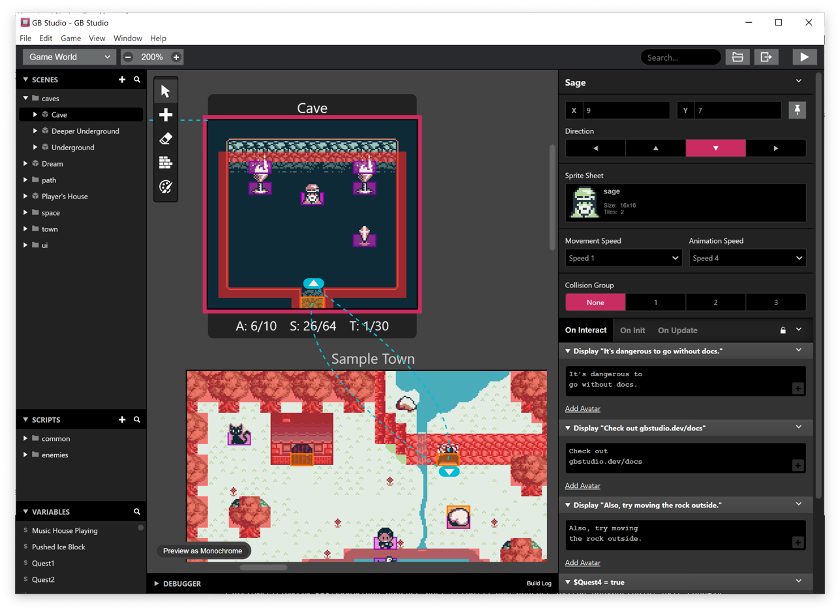
Figure 5. Screenshot of the GB Studio interface (Maltby, 2019), a visual engine for creating Game Boy–style games. Installation & Setup
- Go to https://www.gbstudio.dev and download the installer for your system (Windows, macOS, or Linux).
- Run the installer and follow on-screen instructions.
- Launch GB Studio and start a ‘New Project’ or check out template projects to see some great examples.
Learning Resources The best place to begin is the official documentation, which clearly explains the editor, event scripting blocks, and project setup. For a more hands-on introduction, there are also excellent YouTube tutorials that walk through building a game step by step. Pixel Pete’s series is especially recommended for beginners. • GB Studio Documentation (Introduction | GB Studio, s.d.) • GB Studio Tutorial 1: Getting Started by Pixel Pete (GB Studio Tutorial 1: Getting Started, 2019)
LibreSprite
An open-source sprite editor, forked from the classic Aseprite. It’s lightweight, easy to use, and designed for creating pixel art and animations.

Figure 6. LibreSprite interface screenshot (LibreSprite, n.d.), an open-source sprite editor forked from Aseprite.
Installation & Setup
- Visit https://libresprite.github.io.
- Download the release for your operating system or use via the online editor.
- Load the GB-Studio Pallets via the Hamburger Menu -> Load palettes.
Learning Resources Since LibreSprite is a fork of Aseprite, most tutorials for Aseprite also apply directly to it. This makes it easy to follow along with existing guides and learn the basics of pixel art, layers, and animation. • Aseprite Guide for Beginners (Pixelart Tutorial) by MortMort (Aseprite Guide for Beginners (Pixelart Tutorial), 2017)
MilkyTracker
A cross-platform music tracker inspired by Amiga software from the 90s. It lets you create authentic chiptune and low-fi soundtracks using samples. While GB Studio includes beginner-friendly tools for generating simple chiptune tracks, you may prefer to use a traditional tracker like MilkyTracker.
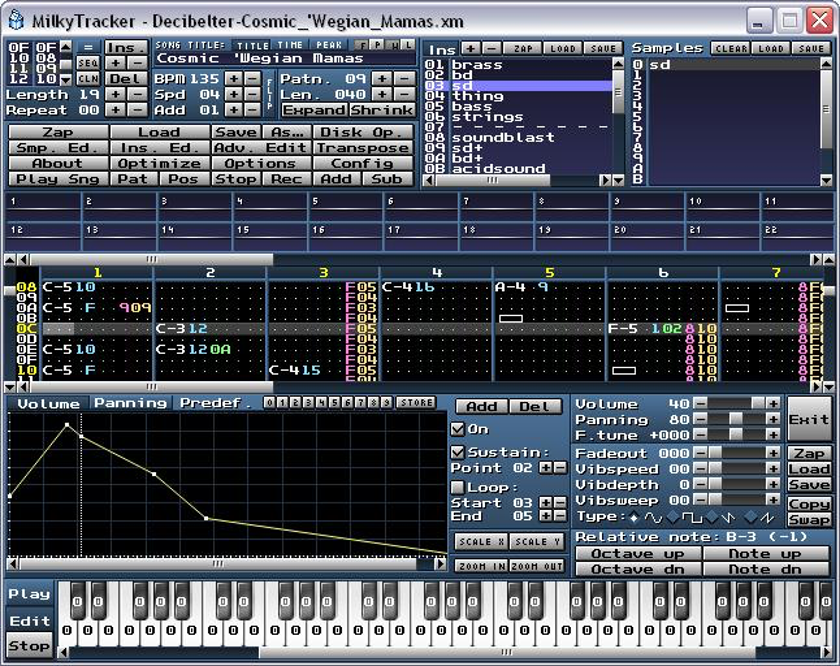
Figure 7. Screenshot of MilkyTracker interface (MilkyTracker, n.d.), an open-source tracker inspired by Amiga software.
Installation & Setup
- Head to https://milkytracker.titandemo.org and download the version for Windows, macOS, or Linux.
- Install using the package manager (Linux) or run the installer (Windows/macOS).
- Open MilkyTracker and load ‘template.mod’ found within the GB-Studio project directory under ‘ProjectName/assets/music/.’
- Save the ‘template.mod’ as a ‘.xm’ for when editing your music and export as a ‘.mod’ when you are ready.
Learning Resources MilkyTracker can feel unusual at first if you’ve only used modern DAWs, since it follows the tracker tradition of vertical, grid-based sequencing. The official documentation covers the basics of the interface, pattern editor, and instrument management. • MilkyTracker Documentation (MilkyTracker | Documentation, s.d.) • Using MilkyTracker | GB Studio Music Tutorial by Goodnight Girl (Using MilkyTracker | GB Studio Music Tutorial, 2019)
Biography
Syed Bokhari is a senior lecturer in Games Development and Programming and University for the Creative Arts. Born in South West London, Assad began his journey in the games industry in 2012, initially working on Flash games as an audio designer and composer. His passion for interactive media and system design led him into audio implementation and, eventually, full-time engineering and game development. In 2015, he co-founded Arrogant Pixel, an independent game studio, and released The Tale of Doris and the Dragon: Episode 1, which received critical acclaim – earning a Frontpage Feature and Daily 3rd Place on Newgrounds (2015), followed by a Bronze Award from Pocket Gamer for its Steam release in 2016. His more recent work includes Nephilim Resurrection which won Best Audio Design at the GDL Indie Awards in 2024.
References
Aniel, A. (2022) Itchy, tasty: an unofficial history of Resident Evil. (Paperback edition) London: Unbound.
Beil, B. (2017) ‘Widerstandsbewegungen – Tendenzen der De-Mediatisierung des Computerspiel(en)s.’ In: Pfadenhauer, M. and Grenz, T. (eds) De-Mediatisierung: Diskontinuitäten, Non-Linearitäten und Ambivalenzen im Mediatisierungsprozess. Wiesbaden: Springer Fachmedien, pp.127–144. https://doi.org/10.1007/978-3-658-14666-5_7 (Accessed 07/09/2025).
Bogost, I. and Montfort, N. (2009) Racing the Beam: The Atari Video Computer System. Cambridge, Mass: MIT Press.
Byrne, J. (2008) Soundless Mountain II [PC freeware game]. Available at: https://superflatgames.com/ (Accessed: 06 September 2025).
Capcom (1995) Street Fighter II [Game Boy]. Osaka: Capcom.
Capcom (2001) Resident Evil Gaiden [Game Boy Color]. Osaka: Capcom. Box art image available at: https://upload.wikimedia.org/wikipedia/en/d/dd/Resident_Evil_Gaiden_Boxart.gif (Accessed: 28 September 2025).
Capcom (2017) Street Fighter IV: Champion Edition [iOS/Android]. Osaka: Capcom.
Carlsson, A. (2008) ‘Chip music: low-tech data music sharing’, in Collins, K. (ed.) From Pac-Man to Pop Music: Interactive Audio in Games and New Media. London: Routledge, pp. 153–162.
Cerezo-Pizarro, M., Revuelta-Domínguez, F.-I., Guerra-Antequera, J. and Melo-Sánchez, J. (2023) ‘The Cultural Impact of Video Games: A Systematic Review of the Literature’, Education Sciences, 13 (11), p.1116. Available at: https://www.mdpi.com/2227-7102/13/11/1116 (Accessed: 07 September 2025).
Chojnacki, M. M. (2017) ‘„Jak za dawnych dobrych lat” – demake a medium gier wideo’. In: Androsiuk, Ł. (ed.) Update. Teorie i praktyki kultury gier komputerowych. 1st edn. Lublin: Wydawnictwo Academicon, pp.13–30. Available at: https://omp.academicon.pl/wa/catalog/view/update-teorie/54/161 (Accessed 06/09/2025). Translated by the author with the assistance of AI tools (self-translation).
Derrida, J. (2012) Specters of Marx: The State of the Debt, the Work of Mourning and the New International. Hoboken: Taylor and Francis. Eurogamer (2025) ‘Bloodborne PSX demake now completely removed, Nightmare Kart continues.’ Available at: https://www.eurogamer.net/bloodborne-psx-demake-now-completely-removed-but-nightmare-kart-continues-with-dlc (Accessed: 07 September 2025).
Fisher, M. (2013) Ghosts Of My Life: Writings on Depression, Hauntology and Lost Futures. Winchester: Zer0 Books.
Fornace, D. (2011) Super Smash Land [PC freeware game]. Available at: https://www.supersmashland.com (Accessed: 06 September 2025).
Fries, E. (2010) Halo 2600 [Atari 2600]. Self-published.
IGN (n.d.) ‘As the Bloodborne PSX Demake Becomes the Latest Fan-Project to Suffer a Copyright Claim.’ Available at: https://www.ign.com/articles/as-the-bloodborne-psx-demake-becomes-the-latest-fan-project-to-suffer-a-copyright-claim-the-creator-of-bloodbornes-60fps-mod-has-offered-his-copium-official-remake-theory (Accessed: 07 September 2025).
Infovore (2008) ‘TIGSource Bootleg Demake Competition.’ Available at: https://infovore.org/archives/2008/09/12/tigsource-bootleg-demake-competition/ (Accessed 07/09/2025).
Lammes, S. (2007) ‘Approaching Game-Studies: Towards a Reflexive Methodology of Games as Situated Cultures.’ In: DiGRA Conference Proceedings. Available at: https://dl.digra.org/index.php/dl/article/download/342/342/339 (Accessed: 07 September 2025).
Lewin, K. (2023) ‘87% Missing: The Disappearance of Classic Video Games.’ Video Game History Foundation. Available at: https://gamehistory.org/87percent/ (Accessed 07/09/2025).
Lexaloffle Games (2015) PICO-8 Fantasy Console [Software]. Available at: https://www.lexaloffle.com/pico-8.php (Accessed: 06 September 2025).
LibreSprite (n.d.) LibreSprite [Software]. Available at: https://libresprite.github.io (Accessed: 28 September 2025). Screenshot reproduced from: https://libresprite.github.io/assets/zeroDark.png (Accessed: 28 September 2025).
LWMedia (2022) Bloodborne PSX [PC fan game]. Available at: https://b0tster.itch.io/bbpsx (Accessed: 06 September 2025).
Maddy Makes Games (2021) Celeste Classic 2: Lani’s Trek [Browser game]. Available at: https://www.lexaloffle.com/bbs/?tid=41282 (Accessed: 06 September 2025).
Maddy Makes Games (2024) Celeste 64: Fragments of the Mountain [PC freeware game]. Available at: https://maddymakesgamesinc.itch.io/celeste64 (Accessed: 28 September 2025). Screenshot reproduced from: https://static.wikitide.net/celestewiki/thumb/0/0d/Celeste64.jpg/1200px-Celeste64.jpg (Accessed: 28 September 2025).
Maltby, C. (2019) GB Studio [Software]. Available at: https://www.gbstudio.dev/ (Accessed: 28 September 2025). Screenshot reproduced from: https://www.gbstudio.dev/img/home/screenshot_win_1_v4.png (Accessed: 28 September 2025).
MilkyTracker (n.d.) Documentation. Available at: https://milkytracker.org/documentation/ (Accessed: 28 September 2025).
Möbius Entertainment (2003) Max Payne [Game Boy Advance]. Rockstar Games. Screenshot available at: https://blogger.googleusercontent.com/img/b/R29vZ2xl/AVvXsEi_bi7YEXrSbSkGcKQD7iVVAYn20AKL4QpLzYczZytq74rXGY1xzqWKO49biIfhE1NylqrQs1_I2TouiEWayRxt8IP9rPkWMn75dyEq8ujXa6vhzYrEQx3ZsrE4V5YvWeq14XRpbxEVqFMV1AOmWv35fnQ506x2idZEMMW7_HfnE_MYmsAj2zFhO54FnDJR/s1600/Max_Payne09(GBA).png (Accessed: 28 September 2025).
Morozov, E. (2013) To Save Everything, Click Here: Technology, Solutionism, and the Urge to Fix Problems that Don’t Exist. London: Allen Lane.
Namco (1984) Pac-Man [Nintendo Entertainment System]. Tokyo: Namco.
Nintendo (1980) Game & Watch [Handheld electronic game]. Kyoto: Nintendo.
Nokia (2000) Tetris [Nokia 3310]. Espoo: Nokia.
Panic (2022) Playdate [Handheld console]. Portland, OR: Panic. PC Gamer (2024) ‘The original Counter-Strike mod is 25 years old, Valve calls it “the greatest videogame ever made”’, 20 June. Available at: https://www.pcgamer.com/games/fps/the-original-counter-strike-mod-is-25-years-old-valve-calls-it-the-greatest-videogame-ever-made/ (Accessed: 07 September 2025).
Pinchbeck, D., Anderson, D., Delve, J., Alemu, G., Ciuffreda, A. and Lange, A. (2009) ‘Emulation as a Strategy for the Preservation of Games: The KEEP Project.’ In: DiGRA 2009 Conference Proceedings. Available at: https://researchportal.port.ac.uk/en/publications/emulation-as-a-strategy-for-the-preservation-of-games-the-keep-pr (Accessed: 07 September 2025).
Stegner, B. (2021) ‘Video Game Ports, Remakes, Remasters, and Reboots Explained.’ Available at: https://www.makeuseof.com/video-game-ports-remakes-remasters-reboots/ (Accessed: 06 September 2025).
Swalwell, M. (2021) Homebrew Gaming and the Beginnings of Vernacular Digitality. Cambridge, MA: MIT Press.
Švelch, J. (2013) ‘Say it with a Computer Game: Hobby Computer Culture and the Non-entertainment Uses of Homebrew Games in the 1980s Czechoslovakia.’ Game Studies, 13 (2). Available at: https://gamestudies.org/1302/articles/svelch (Accessed: 08 September 2025).
Tomczak, S. (2014) ‘Chipmusic, Fakebit, and the Discourse of Authenticity in the Chipscene.’ Organised Sound, 19 (1), pp. 68–77. Available at: https://www.researchgate.net/publication/262639211_Chipmusic_Fakebit_and_the_Discourse_of_Authenticity_in_the_Chipscene (Accessed: 08 September 2025).
Tucker, I. (2013) ‘Evgeny Morozov: “We are abandoning all the checks and balances”.’ The Guardian, 09 March. Available at: https://www.theguardian.com/technology/2013/mar/09/evgeny-morozov-technology-solutionism-interview (Accessed: 07 September 2025).
Unger, A. (2012) ‘Modding as Part of Game Culture.’ In: Fromme, J. and Unger, A. (eds) Computer Games and New Media Cultures: A Handbook of Digital Games Studies. Dordrecht: Springer Netherlands, pp.509–523. https://doi.org/10.1007/978-94-007-2777-9_32 (Accessed: 07 September 2025).
Xenogothic (2020) ‘The Games Industry: Accelerationism and the Hauntological in Microcosm.’ Available at: https://xenogothic.com/2020/06/07/the-games-industry-accelerationism-and-the-hauntological-in-microcosm/ (Accessed: 07 September 2025).
Ziółkowski, J. (2023) ‘Nostalgiczna twórczość fanowska. Wyjaśnienie kategorii demake.’ Replay: The Polish Journal of Game Studies, 10 (1), pp.37–61. Translated by the author with the assistance of AI tools (self-translation).
Only what is switchable is at all
By Sandy Di Yu

About the game
The quotidian, subsumed by digital technologies, has resulted in a strange merging of temporalities and psychic disturbances. How does one reconcile the different scales between human perception and computational operations that vary enough to engender different worlds entirely? How can we begin to think about the possibility of the singularity when the rift remains this large? This game is a speculative fiction meditating on digital objects and the doleful existence of an individual caught between unkept promises and the churning wheels of a system headed towards the end of the world.
About the contributor
Sandy Di Yu is a writer, editor, and PhD researcher in Digital Media at the University of Sussex, focusing on the aesthetics of optimisation to bridge the temporal logics behind computational society with how interfaces and infrastructure are experienced and expressed across cultural industries. Sandy is the co-managing editor of DiSCo Journal and was the PhD Community Advocate for the Sussex Digital Humanities Lab in 2024-2025, where she co-produced the symposium All Consuming AI: Societal & Cultural Impacts, along with a series of workshops exploring digital and data futures.
Girl Math and the Politics of Value
By Silvia Bombardini
Whence arose the illusions of the monetary system?
–Karl Marx, Capital
This puts into question all prevailing economies:
their calculations are irremediably stymied by woman’s pleasure
– Luce Irigaray, This Sex Which Is Not One
1. The Internet of Girls


Fig. 1: @houseofmaeli, TikTok, 23 Feb 2024
Fig. 2: @esmeececilia, TikTok, 17 Sep 2023
To think with girl math we must in the first place think with the context of its emergence, in the summer of 2023, in a tightly woven world wide web of girl relations. The following takes a closer look at both the girl and the math of girl math, and at what theoretical frameworks might complicate our understanding of both. This section pans out to consider the network, what may be described as the internet of girls, at this particular moment in time. And as we set out to do so, it is crucial to acknowledge that while the internet of girls is itself a phenomenon worth investigating, to put all girls in one basket is to miss out on their irreconcilable differences. Some girl relations are relations of opposition. It is tempting, in this respect, to situate the neoliberal, individualist girlboss (est. c.2014) at the opposite end of the spectrum of online girlhood from the tradwife (est. c.2020), uncritically devoted to traditional gender roles. In 2023, however, online girlhood was already split in more than just two poles, as the just-a-girl (Fig. 1) had come to be to the girlboss, what the girl dinner (Fig. 2) was starting to be to the tradwife: antitheses. In response to the exhausting and endless demands that career and family life place on women and girls, participants in both trends were reclaiming to their advantage stereotypes concerning feminine incompetence, frivolity, laziness or irrationality, and taking solace in the resonance of these tactics across social media communities. Though ironic at heart, as they gained popularity, just-a-girl and girl dinner would also come to face inevitable backlash, when the line between reclaiming and reinforcing seemed to blur, and when consumer capitalism, as it’s wont to do, endeavoured to subsume, for example, the girl dinner trend towards the promotion of side dishes at fast food joints (Valinsky 2023).


Fig. 3: @danyaghass, TikTok, 18 Aug 2023
Fig. 4: @marissavargass, TikTok, 20 Oct 2023
It is in the midst of these relations of resonance and opposition, backlash and assimilation, that girl math comes into being, as a way for girls to justify purchases that would otherwise have been difficult to justify. Girl math is used to describe some fairly common practices, such as mentally splitting the cost of an expensive item over the number of times we can predict that item will be used, ordering something extra to get to the free shipping threshold, rounding price tags down rather than up, or considering the refund we might receive from returning products as a bonus to add to our daily or monthly budget (Fig. 3). Not unlike just-a-girl and girl dinner, girl math started out as a joke, arguably in response to an economy in which treating oneself to anything beyond strict necessities seems less and less defensible, but went on to find extensive traction on social media, and was subsequently criticised for perpetuating the very stereotypes it ostensibly sought to make fun of. In 2023, in the United States, not 50 years had passed since women were not deemed financially responsible enough to have a bank account in their owb name, and some felt it was too soon for women and girls to publicly – if ironically – own up to these irresponsible practices (Clark 2023), which is fair to assume are also often exaggerated for entertainment purposes. Moreover, critics observed how girl math videos on TikTok are often filmed in the presence of men – dads and brothers (Fig. 4), boyfriends and husbands, a whole team of male accountants – whose spontaneous reactions to the girl math practices of the woman filming the video support a perspective that portrays men as logical where women are not. It could be argued, however, that provoking these men’s reactions, which range from annoyed to frustrated or alarmed, is the whole point of explaining girl math to them. In other words, that what women and girls are filming and sharing with other women and girls, for entertainment purposes across social media communities, are the annoyance, frustration, or alarm of logical men.
Another argument against girl math comes from those who believe that women and girls should simply stop justifying themselves, and that the sense of guilt we are conditioned to feel, which prompts us to come up with excuses for how we spend our money, is truly what women and girls should fight. As Erin Wylie and Jonah Weiner of Blackbird Spyplane put it, with respect to clothing, in a Substack newsletter titled ‘Against ‘‘Cost Per Wear’’’:
Is your relationship to putting that s**t on so anhedonic that you would turn the act of rocking a slapper into an ongoing accounting task? … Is your faith in your own enthusiasm for a garment so wobbly that you need to buttress & leverage it with spurious math? (Wylie and Weiner 2024)
Yet although cost per wear, or cost per use practices are often referenced in girl math content, there’s nothing actually apologetic about the results one gets when searching for the hashtag on TikTok. Girl math is an online joke, yet the women and girls who take part in the trend tend to explain their practices as one would share financial advice: enthusiastically, occasionally with actual blackboards. The audience recognise tactics they already use, learn new ones, and populate their comment sections with more girl math axioms that contribute to the growth of this subject field. It’s unclear whether any guilt was ever actually felt by these content creators or their audience, but if it was it is exorcised in this collective exercise. ‘I wonder how much money I could have saved if I wasn’t just a girl’ wonders TikTok user @_.sbxb, for example, in the caption of a video showing drawers after drawers of pale pink hair accessories, makeup, fragrances, jewellery (Fig. 5). The regret here is obviously performative: the just-a-girl creator embraces her own financial irresponsibility, which might resonate with her followers – she might even do so only as an excuse, in order to display a treasure trove of items that her audience might envy her for, and no less directly her spending power. But what if the regret was earnest? Girl math should not be taken seriously, but if it were, it could certainly assuage @_.sbxb’s guilt. To the just-a-girl wondering how much money she could have saved if her spending habits were more responsible, girl math promises that her purchases are, in fact, sensible in the long term. Saving money, in girl math, is never more responsible than buying stuff. If unlike girl dinner, girl math cannot be commodified, this is only because it already is at heart all about impulsive purchases. Consumer capitalism should lap it up.
Except it doesn’t, or not quite. There’s something in girl math somewhat sinister to patriarchal capitalism as an ideology. Something that may cause in its defenders, annoyed, frustrated, or alarmed reactions. There is something that this online joke makes fun of, which rubs certain people the wrong way, and it is not the mocking of women and girls’ financial skills that its critics believe it responsible for. The most popular girl math videos are the least logical, yet a certain flair for numbers is arguably necessary to keep up the “ongoing accounting task” (Wylie and Weiner 2024) that girl math would require, if it was taken seriously. Might that thing which girl math trivialises and ridicules not be the monetary system itself? In acknowledging out loud the usually tacit ways that women and girls use to justify their gathering of treasure troves of desirable objects, via a tactical approach to sales and returns or a more or less convincing break down of the price of the item they want – “this sweater cost $400 but I’ve already worn it 7 days in a row … I only have to wear it 6 more weeks, total, as long as I’m alive, before that drops to a mere $8 a wear” (Wylie and Weiner 2024) – is girl math challenging the imperative of financial accumulation as the ultimate goal of the individual in a capitalist society?
1. The Girl and The Math
2.1 The Girl
To appreciate this possibility, it might be necessary to take a step back and clarify where the girl in girl math is situated, not just in the spectrum of online girlhood today, but with respect to the history of gendered relation with the internet and with consumerism in late capitalism. In the 1990s, cyberfeminists welcomed a distancing from our physical bodies and the societal prejudices they are subject to, as the fundamental promise of the internet to women. In Sadie Plant’s words: “There is no authentic or essential woman up ahead … Instead there is a virtual reality” (2000, p. 335). A quarter of a century later, it is not just that the internet has failed to fulfil these fantasies of erasure, but that these fantasies of erasure themselves now seem outdated, contemporary feminisms having grown ever more attuned to the specificities of embodied experience. Meanwhile, in social media trends like girl math, girl dinner and just-a-girl, but also the girlboss and the tradwife, femininity rather than abandoned is hypervisibile and exalted: redeemed, typecast, filtered, radicalized – and perhaps most importantly, monetised. The girl in the flesh does not have to be a girl online, but why would she choose not to? For views and engagement, a girl is the best thing that an internet user can be today. As a result of these circumstances, she who trades her image in the marketplace of images that the internet has become, would seem to have grown ever closer to Tiqqun’s young girl, defined by self-commodification, than to the virtual entity Plant had theorised. Tiqqun’s Preliminary Materials for a Theory of a Young Girl, which was also first published at the turn of the 21st century, did not concern itself with the novelty of the world wide web, but it too divested the girl – specifically, the young girl – of bodily constraints such as gender and age. Yet it did so only to repurpose the term to address, more broadly, the desirable and desiring alienated subject, the first commodity and last shopper of consumer capitalism. Preliminary Materials posits that everyone is a young girl, whose incurable incompleteness in the face of abundance keeps consumerism alive (2012). In a similar vein, the girl online pertains to everyone, human and nonhuman, for to be a girl is “[t]o wish to be perceived, desired, and rewarded for cultivating that desire is the default setting for participating in digital culture” (Quicho, 2023). The girl in girl math specifically, who consumes and films herself consuming, who distributes her image and shares tips that encourage the consumption of others, could be interpreted as the closest embodiment, or a reification, of Tiqqun’s young girl for the present.
Except that there is no actual body to this embodiment. Tiqqun’s young girl only existed offline, and girl math only exists online. And though the internet might long for the corporeal rather than leave it behind, Plant was right at least in her prediction that there are no authentic or essential women in here. On the internet of girls, for views or entertainment, femininity in its physical or behavioural connotations is constructed and exaggerated beyond the limits of offline possibilities, and the creators who post this kind of content understand this and play by the rules of the internet of girls. This self-awareness seeps into their posts, the line between honesty and satire routinely crossed. So perhaps a kind of severance does occur, from a woman’s offline self to her online persona, even when the latter later returns to the body, or rather to a virtual version of it, where gender differences are manufactured and overemphasised. As for the matrilineal relation of the girl on the internet of the girls, and the girl in girl math specifically, to Tiqqun’s young girl, Alex Quicho reminds us, in an online context, not to mistake “girlification for consumer culture itself,” the latter being “the point of the social platform as it has been designed”. If ‘Everyone is a Girl Online’ in Quicho’s understanding, this is because contemporary social media caters to, and produces, desirable and desiring, self-commodifying shoppers. In this milieu:
The girl has only adapted to conditions that have liquidated less cunning subjects … using intuitive knowledge of her environment … to evade complete capture … It’s a rookie move to mistake tactical passivity for a surrender of agency. (Quicho 2023)
Although Quicho does not reference de Certeau specifically, this positions the girl on the internet of girls, and perhaps the girl in girl math all the more, in a tradition of subversive approaches to consumerism, more nuanced than the abstinence of boycotts, that were taking place long before the internet, and that the internet has the potential to amplify. Already in 1980, The Practice of Everyday Life discussed in poetic and oddly prescient terms when read with the hindsight of the digital age, consumer practices which “manipulate the mechanisms of discipline and conform to them only in order to evade them … these procedures and ruses of consumers compose the network of an antidiscipline” (De Certeau 1988, p. xiv-xv, my emphasis). Can girl math not be understood as one such ruse, which through resonance and traction, hashtags and views, becomes an antidisciplinary network on social media platforms? It is through these manipulations of the mechanisms of discipline, de Certeau concludes, that:
an uncodeable difference insinuates itself into the happy relation the system would like to have with the operations it claims to administer. Far from being a local, and thus classifiable, revolt, it is a common and silent, almost sheeplike, subversion – our own. (ibid. p. 200)
2.2 The Math
The discipline that girl math, when it is understood as an antidisciplinary network, manipulates and evades, is math – but more specifically, accountancy. In capitalist economies, it is money as a medium that allows for the extraction of value that occurs in the process of exchange. Capitalism requires a collective suspension of disbelief, in the value of currency, that becomes with time and practice a self-fulfilling prophecy. Girl math’s reliance on “spurious math” (Wylie and Weiner 2024), and yet the way this resonates so widely across social media communities, mimics and ridicules the arbitrariness and fundamental irrationality of this development. And since good Marxists think of money as an equivalent of labour time – a $400 sweater meaning how many hours of skilled labour, exactly? – girl math’s insistence in not taking money seriously, in disrespecting it even, exposes “the truth of commodity exchange, in other words, its lie: the impossibility of making equivalent the incommensurable in human life (classically coagulated in ‘labor time’), and the inert, money” (Tiqqun 2012, p.96). In David Graeber’s interpretation, “Marx’s Capital … is really about the fetishization of money” (2013, p.225). He observes that from Karl Marx’s perspective; capitalism is perverse because it inverts means and ends: what labour produces is not whatever it is that labour produces, but the wage, and the wage is intrinsically linked to financial accumulation. Whether or not the woman or girl who posts girl math content online truly follows these principles in real life, the girl in girl math as an online persona is broke but pampered, self-indulgent while in debt, and not stressed about it. Though her impulsive purchases allow for extensive value extraction, her dismissal of economic wealth as a value worth pursuing in itself situates the girl in girl math at odds with the capitalism ideal. Commodity fetishism, of course, is at play here, yet her shameless favouring of products over money reverts the inversion of ends and means that capitalism promotes.
Is there a higher purpose to this reversion and dismissal, to this exposure of irrational equivalences and ridiculing of arbitrary value systems? To this manipulation, this common and sheeplike subversion? This is, admittedly, unlikely. Like many other girls online, the girl in girl math can be destabilizing to the patriarchal order without being per se an emancipatory subject (Quicho 2023). But her focus on money, or rather, her shifting of focus away from money as an obstacle from getting what she actually wants rather than as an end in itself, draws attention to and disrupts some of the foundational illusions of capitalism, in such a way that might be instrumental for a fruitful questioning of their legitimacy. And what is it that she actually wants? An expensive sweater, a treasure trove of fragrances, sure. But what these desires actually sublimate, is what women have always wanted: “a different economy more than anything else” (Irigaray 1985, p.29-30). Long before the internet’s broken promise of freedom for the constraints of the female body, long before girls online embraced a manufactured and exaggerated version of femininity, conforming on the surface to the imperative of self-commodification only so that they could evade complete capture, Luce Irigaray envisioned this different economy, as one where resources are “exchanged without labor, freely given, exempt from masculine transactions”. Rather than a utopic proposition, she argued that “this mode of exchange has undermined the order of commerce from the beginning” (ibid., p.197). While not emancipatory per se, it is to this undermining that girl math, inadvertently or not, may be understood to contribute.
Biography
Dr Silvia Bombardini is an Associate Lecturer, currently teaching at the London College of Fashion, the London College of Communication, and Central Saint Martins, having previously taught at the Royal College of Art. For her PhD in Visual Sociology at Goldsmiths University, which was part of the ERC-funded ‘Politics of Patents (POP)’ project, she researched shoplifters’ clothes at the turn of the 20th century. For her MRes, in Visual Cultures, she put forth a revaluation of luxury counterfeits from feminist, postmodern, and postcolonial perspectives. Silvia contributed to edited books (Radical Fashion Exercises, The Cultural Construction of Hidden Spaces), and peer-reviewed journals (The Sociological Review, Excursions). Before academia she worked as a journalist for several international publications, and most regularly ran a ‘Coming of Age’ column for Modern Weekly China. Silvia is also a film curator, and has worked with ASVOFF and MUBI.
References
Clark. 2023. ‘The “Girl Math” Trend Proves That Women Are Still Apologising for Their Spending’. The Independent, 3 November 2023, sec. Lifestyle. https://www.independent.co.uk/life-style/girl-math-trend-tiktok-money-expert-b2440515.html.
De Certeau, Michel. 1988. The Practice of Everyday Life. Translated by Steven Rendall. Berkeley: University of California Press.
Graeber, David. 2013. ‘It Is Value That Brings Universes into Being’. HAU: Journal of Ethnographic Theory 3 (2): 219–43. https://doi.org/10.14318/hau3.2.012.
Irigaray, Luce. 1985. This Sex Which Is Not One. Translated by Catherine Porter. Ithaca, New York: Cornell University Press.
Plant, Sadie. 2000. ‘On the Matrix: Cyberfeminist Simulations’. In The Cybercultures Reader, edited by David Bell and Barbara M. Kennedy, 325–36. London: New York: Routledge.
Quicho, Alex. 2023. ‘Everyone Is a Girl Online’. Wired, 11 September 2023. https://www.wired.com/story/girls-online-culture/.
Tiqqun (Collective), and Ariana Reines, eds. 2012. Preliminary Materials for a Theory of the Young-Girl. Semiotext(e) Intervention Series 12. Los Angeles, CA : Cambridge, Mass: Semiotext(e) ; Distributed by MIT Press.
Valinsky, Jordan. 2023. ‘Popeyes Is Now Offering “Girl Dinner.” Here’s What’s Included | CNN Business’. CNN. 20 July 2023. https://www.cnn.com/2023/07/20/business/popeyes-girl-dinner.
Wylie, Erin, and Jonah Weiner. 2024. ‘Against “Cost Per Wear”’. Blackbird Spyplane (blog). 12 November 2024. https://www.blackbirdspyplane.com/p/against-cost-per-wear.
Editor's Introduction: Issue 3 (2025)
By Sandy Di Yu and April Wei-West
Eschaton sans extinction
The gloss of accelerationism
Back then, the eschatological hope constituted the course of “history,” since the ancient cyclical nature of time, which had been forbidden for all of history, was abolished [aufgehoben] by the fact that whatever remained would course forwards down a one-way street in the direction of the “kingdom.” On the contrary, when we anticipate the end, we anticipate the end of history. – Günther Anders, Apocalypse without Kingdom
To secede from or disavow capitalist machinery will not make it disappear. Likewise, suggestions to pull the lever on the emergency brake of embedded velocities, the call to slow down and scale back, is a possibility available only to the few–a violent particularity of exclusivity–ultimately entailing catastrophe for the many. – The Xenofeminist Manifesto
There is a palpable gloom in the sooted air of our post-digital condition. It lands on your skin, sticky like tar, weighing down eyelids and rendering limbs motionless. Can you feel it too, this grief for the hauntological reverie of futures imagined yet unachievable, a seasonal depression for the endless final season?
The world's impending end induces catatonia in even the most sprightly of us, turning earnest hope into ironic despondence. This “secularised Christian eschatology” has dominated Western critical discourse since Cold War times, resurfacing every few years in more potent forms as the horizon of an open future is foreclosed in the wake of anthropocentric climate emergency, algorithmic governmentality, and data-driven fascist pipelines. Each is exacerbated by the open availability of generative artificial intelligence and derivative investment, feeding off of us to spit out uncanny versions of our un-potential selves. None of us asked for this. I hate it here; can we leave yet?
In this desolate post-digital landscape, there exist echoes of techno-optimists who once touted the possibility of escape by pummeling through the murk of capital itself. The accelerationists, who are neither innately technological nor digital, revel in the contradictions of late modernity. Where algorithms materialise as autonomous occult forces, there is no more happy A to B, no more neat beginning to end, no more linear ecology of emergent properties. Instead, there is only a vast inhuman matrix, magnetised around the digital monolith chilling in the backseat of a Cybertruck ploughing towards the end of the world.
But accelerationists put a chokehold on the digital automaton, practising in magic to tame its occult power in a ploy at aesthetic future-ing; the making of internal sabotage. In their most contemporary iterations, accelerationists are wrapped in a gloss that despair cannot adhere to, hardening into a candy-coated shell impenetrable by doomerism and extinction. They slide slickly towards, and through to, the end of all that is known, breaking open another chapter hidden beneath the eschatological façade of our shared narratives. In the face of the apocalypse, can we borrow and redistribute this accelerationist gloss to restore the missing historicism of our apocalyptic times? Could it be swallowed to lubricate our festering intestines, to help pass the red or black pill that constipates our imagination? Can we use it like varnish or glue to cover the vulnerable and the broken in an attempt to mend or enact care, such that our present reality, suffused by the dominion of the digital, might unfold into an epoch beyond the end of history? And if we cannot co-opt the gloss, is there a way to occupy a liminal space that operates outside of the accelerationist-eschatological sphere?
In the third iteration of DiSCo Journal, we pose these questions as background noise to theorists and practitioners, for them to concretise the future fog into shapes that may offer unexpected methods for resistance and breakage. Withholding a normative stance on accelerationism as a reality/practicality, we revisit this controversial ideology through a softer, silkier speculum, a way to shield against the dire onslaught of post-digital anguish.
How to Grow A Movement
By Umi Hsu
Sound essay, 30:53
"How To Grow A Movement" is a living thought fermentation on catalytic impulse, relational transformation, and mycelial time with social movement thinkers and doers. Inspired by the science and sound of the sugar fungus, this sound ethnography explores the notion of Critical Yeast, a term coined by peacebuilding practitioner and scholar John Paul Lederach. As an alternative to critical mass, Critical Yeast refers to the catalytic coming together of a group of individuals who are not like-minded or like-situated, and can transform in a context of conflict. Based on conversations and participant-observations of baking and fermentation experiments, this sound essay ascertains the who and how related to social movements and interspecies relationships. With location recordings, original music, and sound design, this sound work inquires into the quiet transmutability and multigenerational temporality of fermentation. It is an evocation of movement minutiae and wisdom toward a better more-than-human world.



Credits
How To Grow A Movement was written, mixed, and engineered by Umi Hsu. Music composed by Umi Hsu.
It features voices of:
Marcus Benigno
traci kato-kiriyama
Audrey Kuo
Kwanda Scott
Arden Stern
Aaron Tupac
Grace Umali
Jess Wang
Kenneth Yates
Special thanks to Denny Greene, Ashton Philips, April Wei-West, SOAS University of London, and CHASE Consortium.
Biography
Umi Hsu (pronouns: they/them) was born in Taipei and moved to Virginia in the United States at age twelve. Hsu is a trans nonbinary sound artist and ethnomusicologist. Combining experimental performance, field recording, ethnographic writing, audio narrative, oral history, and songwriting, they make sound art and audio experiments to trace the contours of migration, stories, and memory. Having a bicultural and bilingual background, they use sound as a paralinguistic medium to surface meanings, reconstruct memory, and forge connections.
Works Cited
Brown, Adrienne M. 2017. Emergent Strategy: Shaping Change, Changing Worlds. Edinburgh, Scotland: AK Press.
Lederach, John P. 2005. “On Mass and Movement: The Theory of Critical Yeast”, The Moral Imagination: The Art and Soul of Building Peace. New York: Oxford University Press.
Money, Nicholas P. 2018. The Rise of Yeast: How the Sugar Fungus Shaped Civilization. New York: Oxford University Press.